
From 1 January 2027, every owner-occupied home in Queensland must have interconnected photoelectric smoke alarms. Rental and sold properties have needed them since 2022. Here is exactly what the law requires — and what it takes to bring your place up to standard.
By 1 January 2027, all owner-occupied homes in Queensland must have smoke alarms that are:
If your home was built or last rewired before roughly 2017, it almost certainly does not meet this standard yet.
Not sure what you have? Call 0450 440 569 and we will talk you through it in two minutes.
Queensland phased these rules in by property type. Which deadline applies to you depends on what you do with the property.
Deadline:
1 January 2027
This is the group the 2027 date was written for. If you own and occupy your home, you have until 1 January 2027 to have compliant interconnected photoelectric alarms installed throughout.
There is no inspection scheme that comes knocking — but the obligation is yours, and it matters most at the two moments you least want a problem: when you sell, and when there is a fire.
Already required:
since 1 January 2022
Every rental property in Queensland has needed compliant interconnected photoelectric smoke alarms since 1 January 2022. That applies to new leases and lease renewals.
On top of installation, lessors must test and clean each alarm within 30 days before the start of a tenancy, and replace any alarm that fails or reaches 10 years of age.
Already required:
since 1 January 2022
Any home sold in Queensland must have compliant interconnected photoelectric alarms installed before settlement. Sellers are required to state whether the property complies in the sale contract.
It is far cheaper to sort this before the property is listed than to be negotiating it during a building and pest hold-up.
In a strata or body corporate property, responsibility usually sits with the individual lot owner for alarms inside the lot, and with the body corporate for common property. Check your scheme’s by-laws — and if you manage multiple lots, we handle whole-building programs.
Not every smoke alarm sold in Australia meets the Queensland standard. Six things have to be true at once.
Photoelectric alarms detect the smouldering, smoky fires that cause most house fire deaths. They respond ar faster to that type of fire than ionisation alarms do.
The Australian Standard for smoke alarms. It will be printed on the back of the alarm. Anything referencing an older version of the standard does not qualify.
Ionisation alarms are no longer permitted in Queensland homes. If yours has a radioactive material symbol or lists “Am-241” on the back, it is an ionisation alarm and has to go.
Every alarm carries an expiry or manufacture date. Sensors degrade — at 10 years the alarm must be replaced regardless of whether it still beeps when tested.
Either wired to mains power with battery backup, or a sealed unit with a non-removable 10-year lithium battery. Alarms that take a replaceable 9V battery no longer qualify.
Every alarm in the home must be linked, by wire or by radio frequency, so all of them sound together.
Take the alarm off its base plate and look at the back. You are looking for three things: the words “photoelectric”, a reference to AS 3786:2014, and an expiry or manufacture date. If you can find all three on every alarm in the house — and they all sound together when you hold the test button — you are likely compliant.
If any of that is missing, or you would rather not get up on a ladder, call 0450 440 569.
Having the right alarms is only half of it. Placement is written into the legislation, and it is where most DIY installations fall short.
One alarm inside each bedroom — not just in the hallway outside it.
If there is no hallway, the alarm goes between the bedrooms and the rest of that storey.
Including levels with no bedrooms — on those levels, the alarm goes in the most likely path of travel out of the home.
Wall mounting is a fallback, not the default.
where the ceiling meets a wall. Corners are dead air spaces — smoke does not reach them reliably.
Typical three-bedroom, single-storey home — 4 alarms
Typical four-bedroom, two-storey home — 6 alarms
Interconnected means all the smoke alarms in your home are linked together. When one detects smoke, every alarm in the house sounds at once.
It matters more than people expect. A fire that starts in the lounge at 2am will set off the lounge alarm — but if that is the only alarm sounding, the people asleep at the far end of the house behind a closed door may not hear it in time. Interconnection means the alarm in their bedroom sounds too.
There are two ways to achieve it:
The alarms are physically joined by a signal wire. It is the most reliable method and the standard approach in a new build or a full rewire, because the cable can be run before the ceilings are closed up.
The alarms talk to each other by radio signal, and are paired during installation. This is what we use in most existing homes — it delivers the same compliance outcome without pulling up ceilings or cutting into plasterboard.
Both are fully compliant. What matters is that the alarms are compatible with each other — mixing brands or models usually will not pair, which is one of the more common reasons a DIY install fails to meet the standard.
| Hardwired (240V) | 10-year sealed battery | |
|---|---|---|
| Best suited to | New builds, renovations, full rewires, homes that already have hardwired alarms | Existing homes, retrofits, homes with no existing alarm wiring |
| Power | Mains power with battery backup | Non-removable 10-year lithium battery |
| Keeps working in a blackout | Yes — battery backup | Yes |
| Installation | Licensed electrician required | Licensed electrician recommended; must still meet placement and interconnection rules |
| Ceiling access needed | Usually yes | No |
| Compliant in QLD | Yes | Yes |
Our usual recommendation
For an existing home, wireless interconnected alarms with sealed 10-year batteries are what we install. Same compliance, one visit, no ceiling damage, and nothing to remember for a decade. If your home already has hardwired alarms in place, we replace them like for like and interconnect them.
Anything connected to 240V mains power must be installed by a licensed electrician. In Queensland that is not optional.
You can buy sealed 10-year alarms and mount them yourself. The honest answer is no, not legally.
For hardwired alarms — yes, legally. Anything connected to 240V mains power must be installed by a licensed electrician. In Queensland that is not optional.
For battery-powered alarms, the honest answer is no, not legally. You can buy sealed 10-year alarms and mount them yourself.
What we see in practice, though, is that most self-installed jobs miss something: alarms that will not pair with each other, a missing alarm in a hallway, a unit fitted too close to a corner or a ceiling fan, or a bedroom left out because it was being used as an office at the time. The alarms are on the ceiling, the homeowner believes the house is compliant, and it is not.
The other thing you do not get from a DIY install is documentation. When you come to sell or lease the property, being able to produce a compliance certificate from a licensed contractor is what settles the question.
We install, interconnect, test and certify the whole home in a single visit, and leave you with written confirmation of compliance.
Most homes are a straightforward job. Here is the scope:
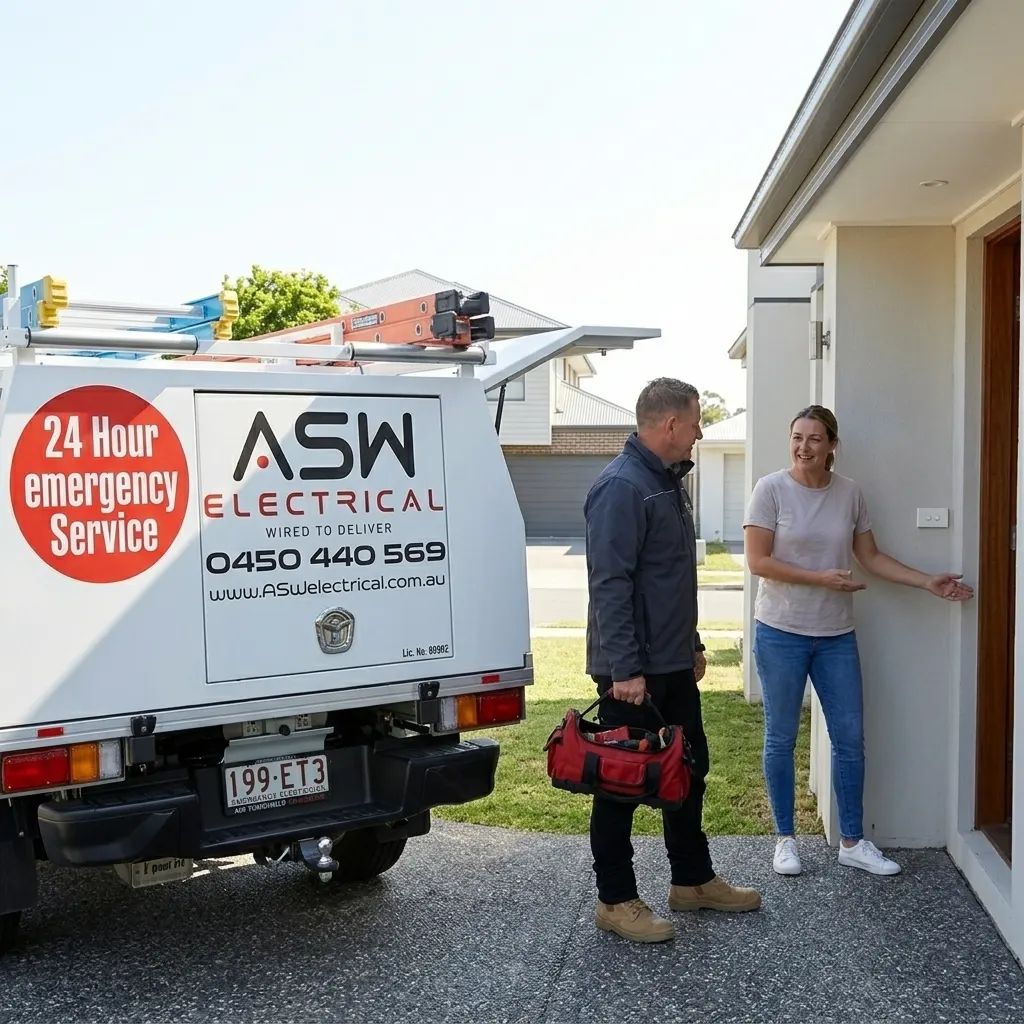
Timing
A typical three or four bedroom home is a same-day job, usually a couple of hours. Larger and two-storey homes take longer. We will give you a firm quote before we start, and we do not proceed until you approve it.
These are the shortfalls we find again and again in homes the owner genuinely believed were compliant. Worth a quick check against your own.
Under the current rules, every bedroom needs its own alarm. A single alarm in the hall was compliant under older regulations and is the most common shortfall we find in homes built before 2017.
Wireless alarms only pair with compatible units, usually the same make and model. Two different brands on the same ceiling are two separate alarms, not an interconnected system — even if both are photoelectric and both are new.
An alarm that still chirps when you press the button can still be non-compliant. Sensors degrade over time, so the law puts a hard 10-year limit on them. If your alarms went in during a 2015 renovation, they are due now.
Ionisation alarms are no longer permitted in Queensland homes. Working or not, they need to be replaced with photoelectric units.
An alarm that goes off every time someone makes toast is an alarm that gets pulled off the ceiling within a month. Correct positioning is not just about compliance — it is what stops the system being defeated by the people it protects.
ASW Electrical has been carrying out electrical work across Brisbane, Logan and South East Queensland for more than 25 years. Smoke alarm compliance is routine work for us — we assess the whole home, install and interconnect compliant alarms, test the system and give you written confirmation that your property meets the Queensland requirements.
One visit. Fixed quote before we start. Backed by our lifetime workmanship guarantee.
Why the bedroom count and selling question: both let the team quote accurately over the phone and identify the higher-urgency leads — a seller with a settlement date converts immediately. Keep the form to five fields: name, suburb, phone, number of bedrooms, and whether the property is being sold or leased.
Tell us how many bedrooms and storeys, and whether the property is being sold or leased.
We check every existing alarm and identify what's needed. You get a firm quote before anything starts.
Compliant photoelectric alarms in every required location, all paired and tested.
Written confirmation of compliance, plus our lifetime workmanship guarantee.
The final stage takes effect on 1 January 2027, when all owner-occupied homes in Queensland must have interconnected photoelectric smoke alarms. Rental properties and properties being sold have been required to comply since 1 January 2022.
Queensland requires photoelectric smoke alarms that comply with Australian Standard AS 3786:2014, contain no ionisation sensor, are less than 10 years old, and are either hardwired or powered by a non-removable 10-year battery. All alarms in the home must be interconnected so they sound together.
You need one in every bedroom, one in every hallway connecting bedrooms to the rest of the home, and at least one on every storey. A typical three-bedroom single-storey home needs four. A four-bedroom two-storey home usually needs six or more, depending on layout.
No. Ionisation smoke alarms are no longer permitted in Queensland homes and must be replaced with photoelectric alarms. You can identify an ionisation alarm by the radioactive material symbol or a reference to “Am-241” on the back of the unit.
No. Alarms can be hardwired to mains power or powered by a non-removable 10-year lithium battery — both are compliant. Alarms that use a replaceable 9V battery are not compliant. Any hardwired alarm must be installed by a licensed electrician.
Battery-powered alarms can legally be installed by a homeowner, but hardwired alarms must be installed by a licensed electrician. In practice, most self-installed systems we inspect fall short on placement or interconnection, and a DIY install does not come with the compliance documentation you need when selling or leasing.
Every 10 years, regardless of whether the alarm still responds when tested. The sensor degrades over time. Every compliant alarm has an expiry or manufacture date printed on the back.
Non-compliance is a breach of Queensland legislation and penalties can apply. For most homeowners the practical consequences show up at sale or lease — sellers must disclose compliance in the sale contract, and lessors must have compliant alarms in place before a tenancy begins. The more serious risk is the one the legislation exists to address.
There is no mandatory government certificate, but written confirmation from a licensed electrical contractor is what property managers, buyers and conveyancers ask for. We supply it as standard with every smoke alarm installation.
We cover Brisbane, Logan and surrounding suburbs including Springwood, Beenleigh, Jimboomba, Browns Plains, Loganholme, Slacks Creek and Park Ridge. Call 0450 440 569 and we will confirm straight away.
Don’t see your suburb? Give us a call — we cover a wide area and can often accommodate requests outside our standard zones.